The ANC’s Destruction of Technikons: A Communist Experiment That Crushed Opportunity and Killed South African Industry expertise

The Tragic Dismantling of South Africa’s Technikons: A Case Study in Political Mismanagement
South Africa’s technikons were once the backbone of the country’s industrial and technical progress, churning out skilled graduates who directly fueled the nation's powerhouse companies such as Sasol, Iscor (now ArcelorMittal South Africa), Eskom, Denel, and Transnet. These institutions specialized in applied sciences, engineering, and practical skills, bridging the critical gap between theoretical knowledge and real-world industry needs.
Then came the post-1994 government, led by the African National Congress (ANC), with an agenda that went beyond transformation—it became a wrecking ball for efficiency, meritocracy, and economic pragmatism.
How Technikons Built the Economy
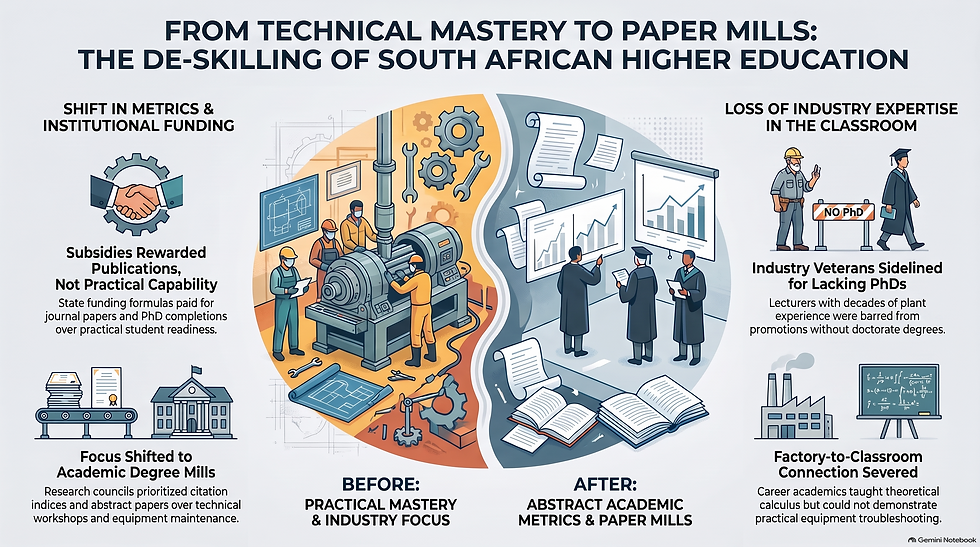
Before their ill-advised reclassification into “Universities of Technology” in the early 2000s, technikons played a unique role in the higher education landscape. Unlike traditional universities, which focused primarily on academic and theoretical knowledge, technikons provided hands-on, job-ready skills tailored for the industrial and commercial sectors.
These institutions had a reputation for:
Producing graduates who were immediately employable and could integrate seamlessly into high-demand industries.
Working closely with South Africa’s biggest state-owned enterprises (SOEs) to create a talent pipeline that kept the country’s energy, mining, and manufacturing sectors competitive.
Emphasizing vocational and technical skills, ensuring that graduates didn’t just leave with degrees but with actual, applicable competencies.
Streamlining higher education into an efficient, dual system—where universities focused on pure academics and research, while technikons trained people to fill critical industrial gaps.
This model worked brilliantly.
Technikon Witwatersrand (TWR), for example, was a powerhouse in engineering, construction, and applied sciences. It had a direct pipeline to industries like Sasol and Eskom, producing graduates who could walk out of class and straight into the economy’s engine room. The same was true for institutions like Pretoria Technikon, Port Elizabeth Technikon, and Cape Technikon.
Enter the ANC: The Madness of ‘University Status’
Then, politics took over. The ANC government, drunk on ideology rather than economic pragmatism, decided that the entire education system needed “transformation.” This led to the reckless dismantling and forced mergers of technikons into universities.
The so-called "higher education restructuring" of 2004-2005 saw:
The forced rebranding of technikons into "Universities of Technology," effectively erasing their distinct identity.
The absorption and destruction of legendary institutions like Technikon Witwatersrand, which was swallowed by Rand Afrikaans University (RAU) to form the University of Johannesburg.
The disappearance of industry-driven curricula, as many new universities of technology drifted towards unnecessary degree programs rather than maintaining a strong vocational focus.
A loss of efficiency and skills development, as many technikons had to restructure their programs to fit university models that were never designed for applied learning.
This was sheer madness.
Instead of recognizing that a dual education system—one for academic knowledge and one for applied technical skills—was crucial, the ANC bulldozed its way through with its obsession to equalize everything, even at the cost of excellence.
The Fallout: A Country Deprived of Technical Expertise
The impact of this foolish policy has been catastrophic.
SOEs Have Collapsed Under Skills Shortages
Eskom, once a world-class power utility, has suffered from a severe lack of skilled engineers and technical staff.
Transnet and PRASA are plagued by operational inefficiencies because the pipeline of well-trained, job-ready technikon graduates has dried up.
Sasol, once a shining beacon of South African engineering excellence, has been forced to look abroad for talent in chemical engineering and industrial operations.
Graduates Are Unemployable
Universities of Technology have watered down their programs, and many graduates now hold degrees with limited practical industry applications.
Unlike before, where a Technikon graduate could walk straight into a job, today's UoT graduates struggle to meet industry expectations.
The Artisan Crisis: The Country Can’t Build Anything
Before the merger, technikons produced highly skilled artisans, builders, and engineers who could work on large-scale infrastructure projects.
Today, South Africa faces a critical shortage of qualified artisans and technicians. Companies are now importing artisans from Zimbabwe and China to do work that once proudly belonged to South Africans.
The Erasure of a Proven Model
Countries like Germany, Switzerland, and Austria continue to thrive using a dual education system—universities for academic knowledge and technical institutions for applied skills.
South Africa had the same model but threw it away in favor of a failed one-size-fits-all university approach.
A Political Decision, Not an Educational One
Let’s be clear: this was not about improving education.
It was about political interference and ideological dogma. The ANC wanted to reshape higher education in its own image, regardless of economic logic or the needs of the job market.
Rather than building on what worked, they erased history, merged institutions for the sake of it, and imposed an impractical new model.
The irony? Even today, after two decades of this disaster, no ANC leader will admit that it was a mistake. They will blame apartheid, blame the private sector, blame everyone but themselves for the destruction they caused.
The Way Forward: Can We Fix This?
The reality is that South Africa desperately needs to reinstate a strong technical education model. If we are serious about reviving the economy and restoring industrial efficiency, we must:
Re-establish standalone technical colleges and applied universities—separate from traditional academic universities.
Work directly with SOEs and private industry to create job-ready graduates again.
Focus on vocational excellence, not just degrees—because a piece of paper without practical ability is meaningless.
Remove political interference from education policy and let industry experts, not career politicians, guide the future of higher education.
South Africa was once an industrial and energy powerhouse, and much of that was thanks to the technikon system. If the country ever hopes to restore its former glory, it must undo this ANC-imposed disaster and return to what works.
Because as it stands now, South Africa is paying the price for ideological arrogance—and the bill keeps getting bigger.


Comments